
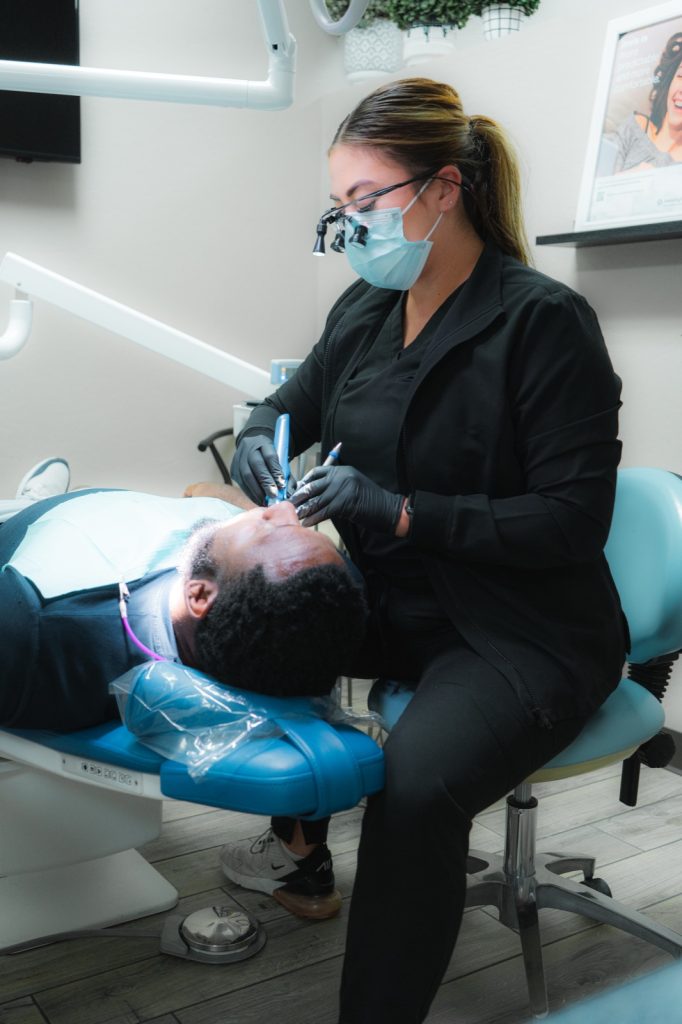
A routine teeth cleaning at Glisten Dental Glendale is the single most evidence-backed dental service we offer. Patients in Glendale who maintain 6-month cleanings keep more teeth, have lower rates of gum disease and decay, spend dramatically less on dentistry over their lifetime, and, per emerging evidence, may reduce their cardiovascular disease risk. An hour every six months is, measurably, one of the best health investments you can make.
What actually happens in a 6-month cleaning appointment
A thorough routine cleaning at Glisten Dental Glendale takes 45-60 minutes and includes far more than “scraping your teeth.”
1. Medical and dental history review (3-5 minutes)
Quick update: new medications, recent hospitalizations, pregnancy, changes in overall health. Why it matters, some medications cause dry mouth (increases decay risk), some cause gum overgrowth (changes cleaning approach), certain conditions (recent joint replacement, heart valve issues) may require prophylactic antibiotics before cleaning.
2. Blood pressure measurement (2 minutes)
We screen BP at every cleaning. Dental offices catch a meaningful percentage of undiagnosed hypertension, patients who don’t see a physician regularly get their first warning from us. If your BP is significantly elevated, we recommend you see your primary care physician before we do elective dental work.
3. Oral cancer screening (3-5 minutes)
Visual and tactile exam of the tongue, floor of mouth, soft palate, cheeks, lips, and neck lymph nodes. Oral cancer is diagnosed in roughly 54,000 Americans annually; early detection (via screenings like this) dramatically improves survival. We examine every patient at every visit. Any suspicious lesion gets documented, photographed, and either monitored or biopsied depending on characteristics.
4. Periodontal assessment (5-8 minutes)
Pocket depth measurements around every tooth (six measurements per tooth, so 168+ readings in a full dentition). Bleeding on probing noted. Recession measured. This data is the definitive assessment of gum health and the basis for recommending routine cleaning vs deep cleaning (scaling and root planing, see our deep cleaning page).
5. Scaling, removing plaque and calculus (20-30 minutes)
Ultrasonic instrumentation plus hand scalers to remove soft plaque and hardened calculus from above and just below the gum line. Calculus is what you can’t remove at home, once plaque mineralizes (within 24-72 hours of forming), no toothbrush or floss will dislodge it. Professional scaling is the only way.
6. Polishing (5-10 minutes)
Prophy paste and a slow-speed handpiece to remove surface stain and smooth the tooth surface. Smooth surfaces accumulate new plaque more slowly than rough ones. Patients often notice their teeth feel and look noticeably cleaner after this step.
7. Flossing (3-5 minutes)
Thorough professional flossing, sometimes catching debris we’ve loosened from the scaling step. We note which areas bleed, a useful diagnostic signal about where home care is falling short.
8. Fluoride treatment if indicated (3 minutes)
Topical fluoride varnish for patients at elevated decay risk, dry mouth, orthodontics, high-decay history, exposed root surfaces from recession. Applied quickly, stays on the teeth for hours. Reduces decay risk by roughly 30% in high-risk patients. Not needed for every patient at every visit.
9. Dental exam by the dentist (5-10 minutes)
The hygienist hands off to Dr. Dawood (or the attending dentist) for the clinical exam. Review of radiographs if newly taken, visual inspection, palpation of TMJ, bite check, identification of any early decay, cracked teeth, failing restorations, or other concerns. This is where new issues get caught before they become emergencies.
10. Discussion and home care review (5 minutes)
Practical guidance based on what we saw. Which areas need more flossing attention. Whether an electric toothbrush would help. Whether a water flosser is right for your anatomy. Whether any specific products (prescription fluoride toothpaste, xylitol mints for dry mouth) fit your situation. Treatment planning for anything we identified.
What X-rays actually accomplish
Bitewing X-rays at routine cleaning appointments (typically every 12-24 months for healthy adult patients, more frequently for higher-risk patients) detect decay between teeth, where visual inspection can’t see. A small cavity on the interproximal surface is invisible clinically until it reaches 2-3mm in size, at which point it’s often already deep enough to need a larger restoration than it would have needed at 0.5mm. Radiation exposure from modern digital bitewings is roughly equivalent to a 1-2 hour transcontinental flight.
Panoramic X-rays every 3-5 years (or when clinically indicated) reveal anatomy not captured by bitewings: wisdom teeth, jaw pathology, sinus issues, TMJ structure, full-mouth alignment. Most patients don’t need panoramic imaging at every cleaning, only when there’s a specific clinical question.
CBCT (cone-beam CT) imaging is reserved for specific clinical situations, implant planning, impacted wisdom teeth, certain trauma cases. Not routine for cleanings.
6 months vs 3-4 months vs 12 months
Six-month routine cleanings are the standard for healthy adult patients. Three-to-four-month intervals (periodontal maintenance) apply to patients with a history of periodontitis, the disease returns faster than the standard 6-month schedule can prevent. Twelve-month intervals apply to a small group of patients with exceptional home care, no decay history, no periodontal history, and low risk, and we document that justification rather than defaulting to it.
Your interval is individualized based on your actual oral health, not a blanket rule.
Home care that makes a measurable difference
- Electric toothbrush twice daily. Outperforms manual brushing for plaque removal in most studies. Pressure sensors prevent over-scrubbing that causes gum recession.
- Interdental cleaning daily. Floss, interdental brushes, or water flosser, the best tool is the one you’ll consistently use.
- Fluoride toothpaste. Non-fluoride “natural” toothpastes look attractive on the shelf but don’t prevent decay meaningfully. Prescription-strength fluoride toothpaste (1.1% sodium fluoride) is available for high-risk patients.
- Low-sugar, low-acid diet. Frequency of sugar/acid exposure matters more than total quantity. Sipping a sugary drink over 2 hours is more damaging than chugging the same amount in 2 minutes.
- Don’t rinse immediately after brushing. Let the fluoride stay in contact with your teeth, spit out excess, don’t rinse.
Cost and insurance
Routine cleaning with exam and X-rays at Glisten Dental Glendale: $150-$250 without insurance. Most dental PPO plans cover two cleanings per year at 80-100% with no deductible, essentially free for insured patients. Uninsured patients can access our in-house membership plan for discounted preventive care. We don’t surprise-bill.
Call 480-630-4446 to schedule your cleaning in Glendale. New patients welcome, existing patients can text or call to book.
Why patients choose Glisten
All your dental work, in one place
Our small team of multi-specialty dentists handles implants, restorative, cosmetic, and orthodontics, so you're not being passed between three different offices to finish your work.
We advocate with your insurance
We file claims directly and follow up with your insurance company on your behalf to help cover what they should, instead of leaving the paperwork to you.
Honest, no-pressure plans
We recommend only what's actually necessary. Your treatment plan is written so you can take it anywhere for a second opinion, no hard sell, no over-diagnosis.